B2B vs B2C: The Real Differences in Marketing & Sales (Egypt & Saudi Arabia)
 Admin-C95-24
·
Admin-C95-24
·
Created: 14 Aug, 2020
Last Edit: 30 Mar, 2026
Table of Contents
B2B (Business-to-Business) means you sell to companies—usually with more stakeholders, higher risk sensitivity, and a longer decision process.
B2C (Business-to-Consumer) means you sell to individuals—typically faster decisions, higher volume, and stronger reliance on experience, convenience, and brand trust.
The real difference isn’t just who buys—it’s how you market, how you sell, how you price, and what success metrics you track.
B2B vs. B2C: Definitions that will truly change your strategy
If your buyer needs internal approvals, budgets, or contracts, you’re closer to B2B. If your buyer is an individual purchasing quickly for personal use, you’re closer to B2C.
What B2B looks like
B2B businesses sell solutions that help organizations operate better—software, consulting, logistics, staffing, security, equipment, or specialized services.
Typical B2B patterns you’ll see in Egypt & Saudi Arabia:
- Requests for proposals/quotations, onboarding discussions, implementation timelines
- “Who will support this?” and “How do we reduce risk?” questions
- A focus on reliability, documentation, service levels, and clear scope
What B2C looks like
B2C businesses sell directly to individuals—retail products, subscriptions for personal use, consumer services, food, beauty, fitness, and many app-based offerings.
Typical patterns of business-to-consumer trade in Egypt and Saudi Arabia:
- Purchase decisions influenced by convenience, speed, social proof, and offers
- High sensitivity to delivery experience, customer support, and returns policies
- Short-form content and reviews often matter more than long documentation
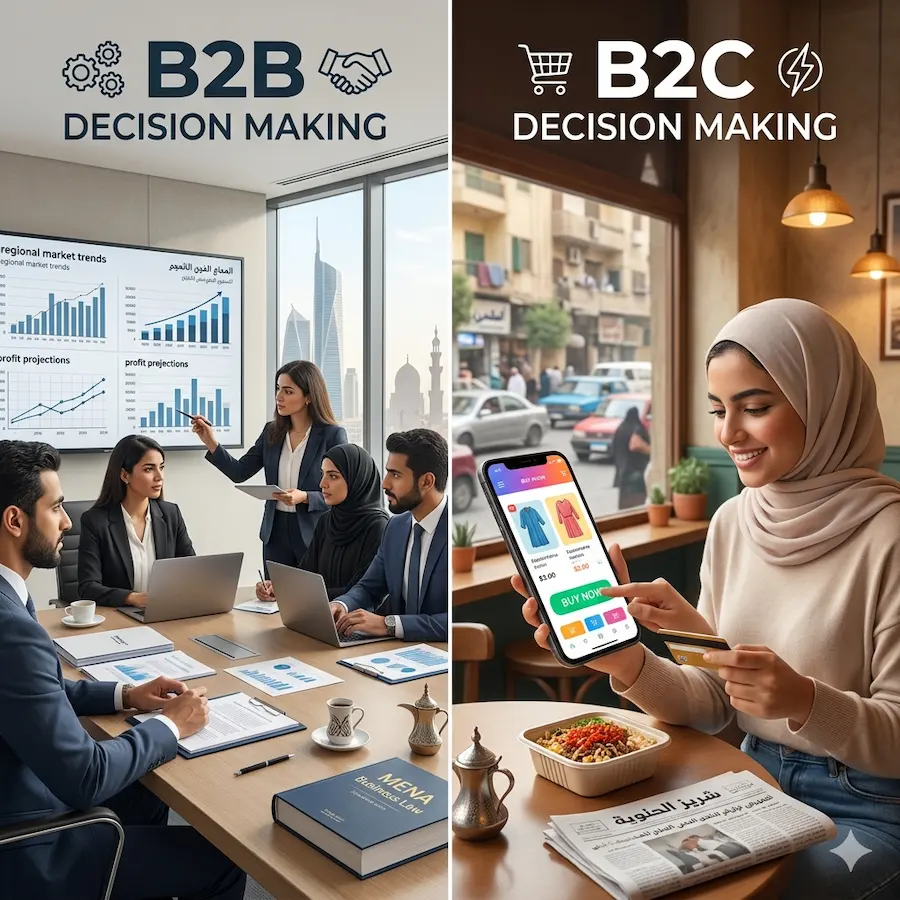
The 60-second comparison table
B2B wins through trust + risk reduction + ROI clarity. B2C wins through speed + experience + value perception.
| Dimension | B2B | B2C |
|---|---|---|
| Buyer | Company / Team | Individual |
| Decision-makers | Multiple stakeholders | Usually one person |
| Sales cycle | Longer (often) | Shorter (often) |
| Deal size | Higher (often) | Lower (often) |
| Key driver | ROI, efficiency, risk | Convenience, emotion, price, experience |
| What closes the deal | Proof + confidence + implementation | Price + trust + UX + social proof |
| Best content | Use cases, case studies, demos | Reviews, UGC, short videos, product pages |
| Growth lever | Pipeline + partnerships | Acquisition + repeat purchase |
Marketing: what changes between B2B and B2C
1) Messages (what they promise)
In B2B, your messaging should answer “Why is this safer and worth it?” In B2C, it should answer “Why this, why now?”
B2B messaging usually works best when it’s:
- Problem-led: “Reduce delays / improve visibility / standardize processes”
- Risk-aware: “Support, onboarding, reliability, governance”
- Outcome-based: “Save time, reduce errors, improve reporting”
Read also: Inspiring eCommerce Ideas That Actually Make Money
B2C messaging usually wins when it’s:
- Benefit-led: “Faster, easier, better value”
- Experience-led: “Simple checkout, quick delivery, friendly support”
- Offer-friendly: “Bundles, limited-time deals, free delivery thresholds”
2) Content (what builds trust).
B2B content that lowers friction:
- Clear solution pages by industry or use case
- Short case studies (even if anonymous) illustrate the results.
- A demo flow + FAQs that address security/support/implementation
- Onboarding steps and timelines
B2C content that converts faster:
- Short videos that show the product in use
- Customer reviews and UGC
- Strong product pages (photos, specs, “who it’s for,” returns info)
- Simple comparisons (“which option fits me?”)
3) Channels (where demand is created)
Choose channels based on where your buyer actively evaluates options, not what’s trending.
A mix of common B2B channels:
- LinkedIn (targeted roles), partnerships, communities, webinars
- Search-led content (problem/solution queries), email nurturing
- Direct outreach (careful, relevant, personalized)
A mix of common B2C channels:
- Meta/TikTok for discovery + conversion
- Google Search for high-intent queries
- Influencers (when trackable), marketplaces, retargeting
Sales: cycle length, stakeholders, and negotiation
Sales cycle structure
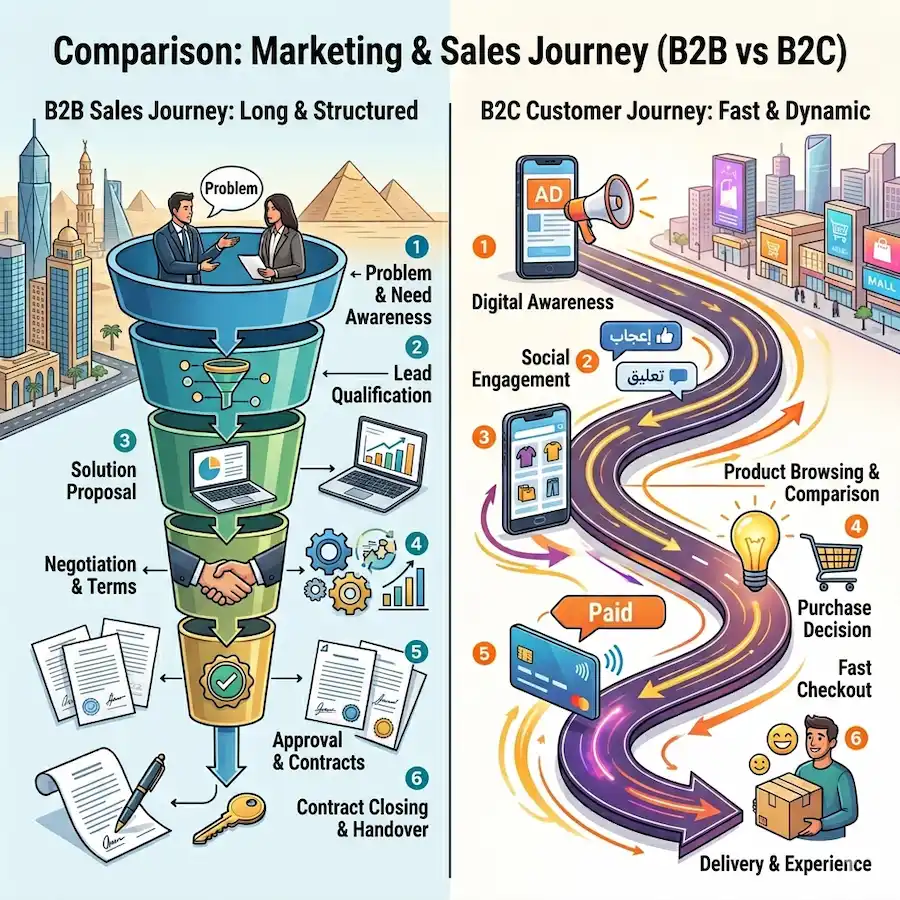
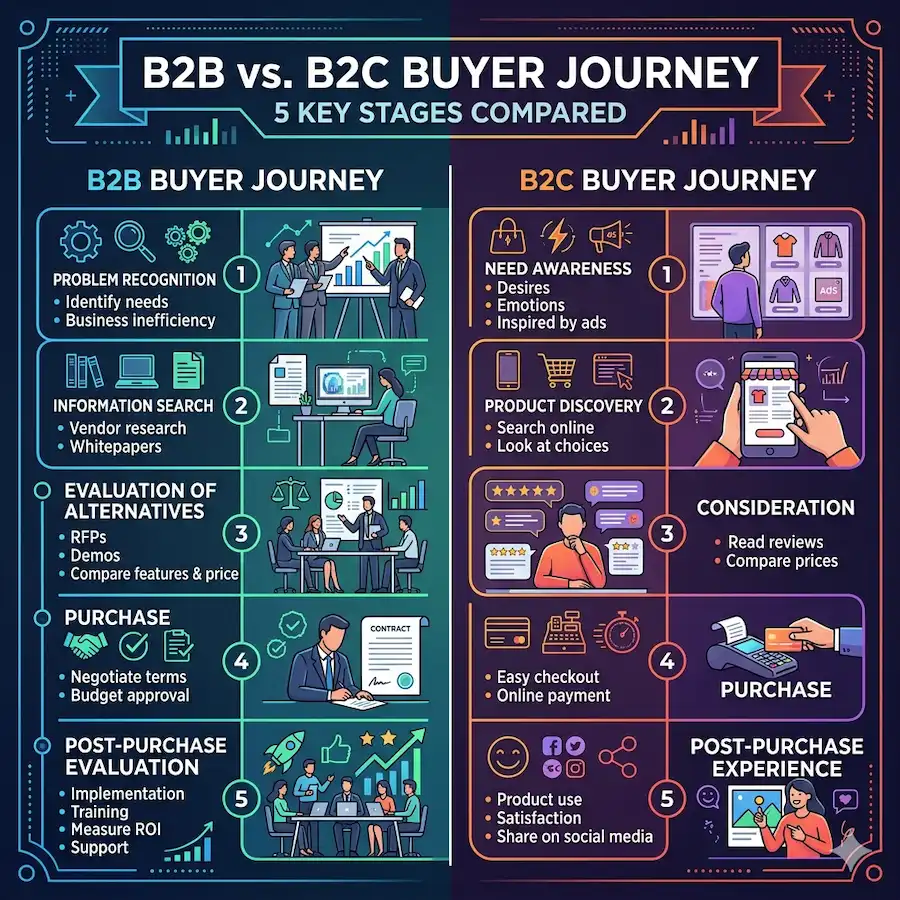
B2B is often multi-step. B2C is often one or two steps.
A typical business-to-business (B2B) workflow: Discovery → Presentation → Demonstration/Proof → Negotiation → Signature → Settlement.A typical business-to-consumer (B2C) workflow: Discovery → Purchase → Delivery/Trial → Repeat Purchase/Customer Retention.
Stakeholders are (extremely) important in business-to-business relationships.
In B2B, you may sell to:
- The user (needs ease)
- The manager (needs impact)
- Procurement/finance (needs cost control and clarity)
- IT/security (needs safety and integration)
Your sales assets should speak to each—without turning your landing page into a textbook.
Pricing & offers: packages vs contracts
B2C pricing needs clarity and speed. B2B pricing can be packaged, but often needs scope and terms.
Pricing patterns in the consumer-oriented business sector:
- Fixed prices, bundles, seasonal offers
- Shipping thresholds, promo codes, subscriptions
- “What’s included” must be crystal clear
Read also: Best web site development company for Business Growth Online
B2B pricing patterns:
- Tiered packages by seats/locations/usage
- Annual contracts with implementation and support terms
- Proof-driven value framing (what changes after adoption)
Common mistake: treating B2B like B2C (one price for all scopes) or treating B2C like B2B (too many steps before checkout).
KPIs: measure the right thing or you’ll optimize the wrong thing
B2B needs pipeline health. B2C needs conversion and retention discipline.
Key performance indicators (KPIs) in the business sector that should be prioritized among companies:
- MQL→SQL conversion, pipeline velocity
- Win rate, average cycle length
- Average contract value, churn/renewals (if subscription)
- Stage-to-stage conversion in the pipeline
Key performance indicators (KPIs) that should be prioritized in consumer-oriented marketing:
- Conversion rate, CAC, AOV
- Repeat purchase rate, return/refund rate
- Customer support response time
- LTV (where you have enough data)
Are you a B2B, B2C, or hybrid company? (Quick checklist)
Many businesses in Egypt & Saudi Arabia are hybrid—selling to both companies and individuals. If so, don’t force one funnel.
You’re closer to B2B if:
- You invoice companies or sign service contracts
- Your buyer needs approvals or procurement steps
- Implementation/support is part of the purchase decision
You’re closer to B2C if:
- Checkout happens quickly on a store/app
- Promotions and social proof heavily influence demand
- Delivery/returns experience is a key differentiator
A hybrid system is likely to be present in the following cases:
- You sell the same product as “personal” and “business”
- You have both “Buy now” buyers and “Request quote” buyers
Action: build two journeys (and often two landing pages) with different messaging and CTAs.
Common mistakes (especially when operating in Egypt & Saudi Arabia)
The biggest mistake is copy-pasting B2C tactics into B2B (or vice versa) without changing the buyer journey.
- B2B with B2C messaging: discounts first, trust later
- B2C with B2B friction: too many steps before purchase
- One funnel for everyone: founders, SMEs, and enterprise buyers behave differently
- Wrong measurement: traffic obsession in B2B instead of pipeline; leads obsession in B2C instead of sales
- Underestimating after-sale experience: support and onboarding (B2B), delivery and returns clarity (B2C)
A 7-step execution plan (by model)
Align your promise, funnel, channels, and KPIs to the model—then iterate weekly based on real behavior.
- Write one clear value statement: “We help [who] achieve [outcome] by [how].”
- List the top 3 objections and create assets to answer them
- Choose the correct CTA:
- B2B: “Request a demo / Get a quote”
- B2C: “Buy now / Order”
- Build one strong landing page before expanding
- Add proof in the format your buyer trusts:
- B2B: process, support, onboarding, use cases
- B2C: reviews, UGC, returns clarity, real photos
- Separate dashboards for B2B vs B2C
- Improve one bottleneck per week (conversion, lead quality, cycle length, retention)
Read also: How to Set your Career Goals
FAQ about B2B vs B2C?
Which is better: B2B or B2C?
Can a business be both B2B and B2C?
Is LinkedIn the only channel for B2B?
What’s the difference between B2B marketing and B2B sales?
Created: 14 Aug, 2020
Last Edit: 30 Mar, 2026
Admin-C95-24
Read Also
وصف متجر إلكتروني جاهز
مميزات المتجر الالكترونى
كيفية تصميم متجر الكتروني جاهز وكيف تختار الأفضل
Inspiring eCommerce Ideas That Actually Make Money
What is a B2C/B2B Hybrid E-Commerce Platform | How It Works